

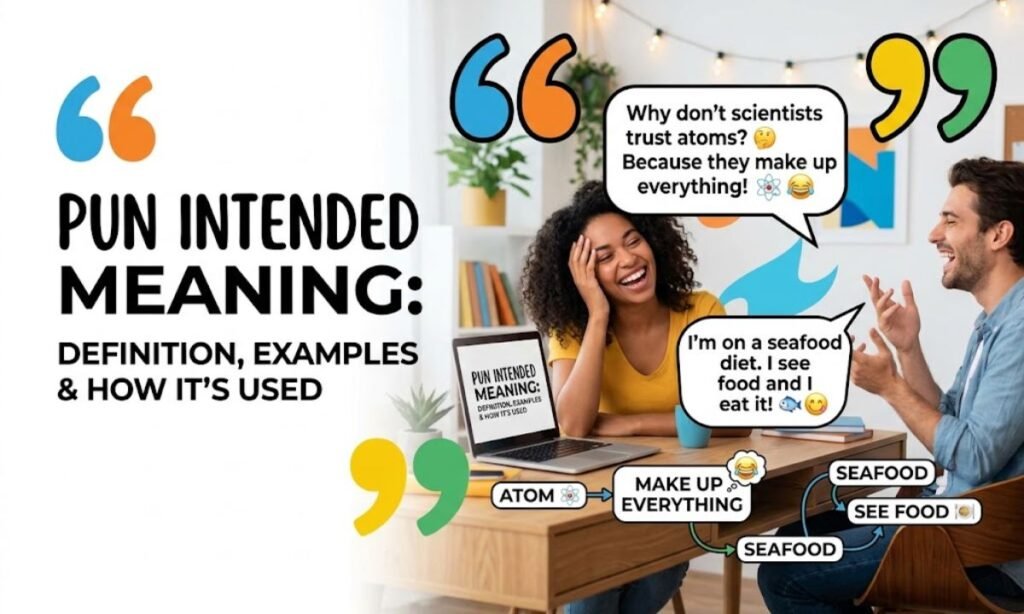
Have you ever heard someone say a joke and then add, “pun intended”? It’s a common phrase people use in writing and speech. It shows that a play on words was made on purpose. This little phrase helps readers catch the joke they might have missed.
The term “pun intended” means the speaker or writer chose their words for a double meaning. It signals that the wordplay was not an accident. People add it right after a pun to point out the humor. This makes the joke land better and avoids confusion.
You can find “pun intended” used everywhere today. It shows up in casual talk, social media posts, and even in articles. Writers use it to add humor and connect with readers. Understanding this phrase helps you enjoy wordplay and use it well yourself.
Random Puns Generator
Random Puns Generator
Need a little laugh? Generate a fresh pun every time!
What Does Pun Intended Mean?
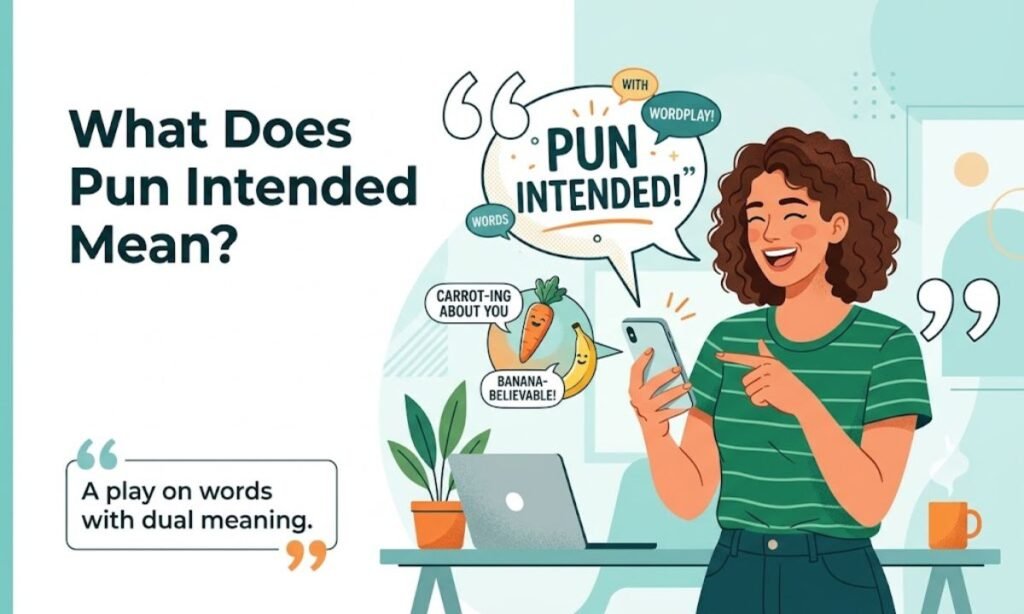
When someone says “pun intended,” they are letting you know that a joke or double meaning in their sentence was made on purpose. It is a small phrase, but it does a big job. It tells the reader or listener that the wordplay they just noticed was not an accident.
Simple Definition
The simple pun intended meaning is this: the speaker chose their words deliberately to create a joke based on double meaning. Instead of leaving people to wonder if a pun was clever or clumsy, the phrase confirms it was clever on purpose.
Explore More Clever Wordplay and Funny Reads
If you enjoy this kind of language humor, there is a whole world of wordplay worth exploring, from classic dad jokes to clever headlines that use double meanings for comedic effect.
Why It Is Used
People use this phrase mainly to make sure their humor lands. Without it, a pun might slip by unnoticed, especially in text or writing where tone is harder to read. Adding the phrase gives the joke a small spotlight.
What Is a Pun? Understanding Wordplay First
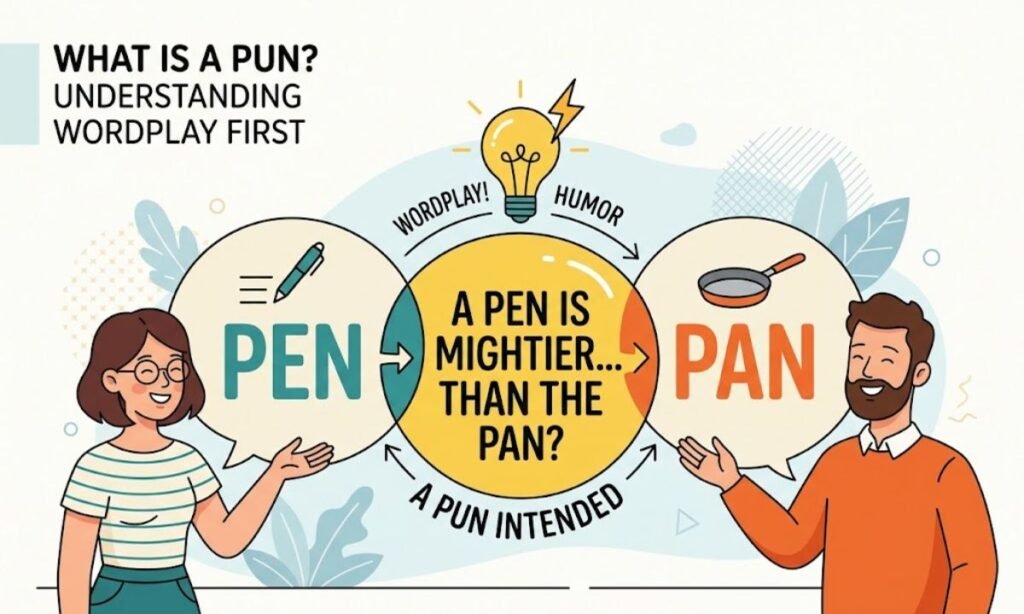
Before the phrase makes full sense, it helps to understand what a pun actually is. A pun is a form of wordplay that uses a word with two meanings, or two words that sound alike, to create a humorous effect. It relies on double meaning, and often works because of how flexible language can be.
For example, saying “I used to be a baker, but I couldn’t make enough dough” plays on the word “dough,” which means both bread mixture and money. That overlap is what makes it a pun.
Types of Puns
Puns generally fall into a few common categories:
- Homophonic puns – use words that sound the same but have different meanings, like “sole” and “soul.”
- Homographic puns – use one word with multiple meanings, like “light” meaning both “not heavy” and “not dark.”
- Compound puns – combine two or more puns in a single sentence for extra effect.
Each type relies on double entendre or double meaning to create the humor, but they get there in slightly different ways.
How Pun Intended Is Used in Sentences
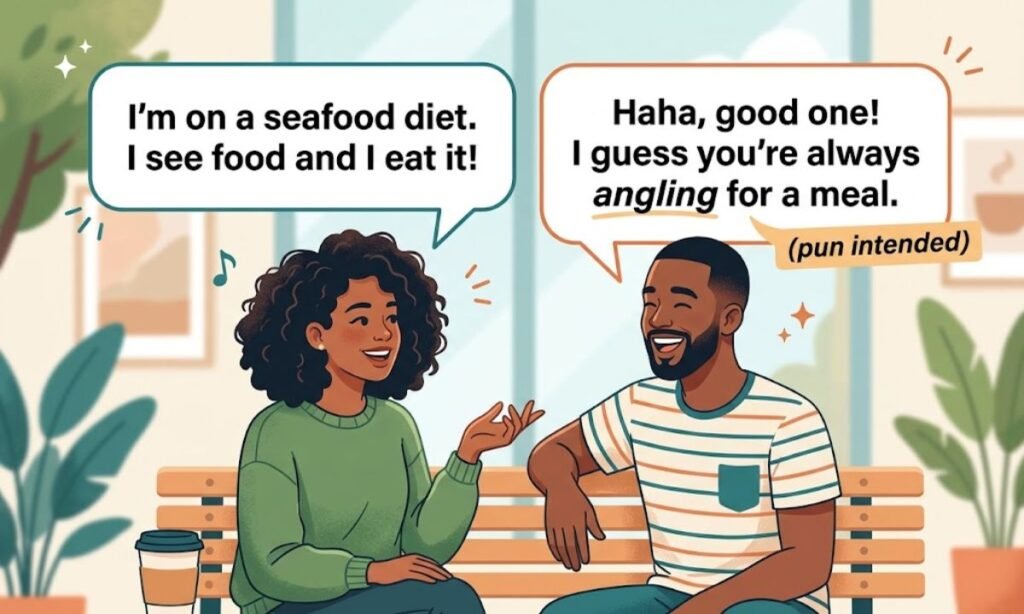
Once a pun has been made, the phrase is usually added right after it, almost like a wink to the reader.
Placement
Most commonly, “pun intended” appears immediately after the pun itself, often set off by a comma or parentheses. This placement keeps the joke close to its explanation.
In Written English
In writing, the phrase is especially useful because tone of voice is missing. A reader cannot hear sarcasm or playfulness the way a listener can, so the phrase helps signal that a joke was meant.
In Spoken English
In speech, people sometimes use it for comedic timing, pausing briefly before adding “pun intended” for extra effect. It can also be used casually, almost as a verbal nudge.
Ten Practical Examples
- “The math teacher said problems make her add up her patience, pun intended.” – The pun plays on “add up,” referencing both math and patience.
- “I’m reading a book about anti-gravity. It’s impossible to put down, pun intended.” – “Put down” refers to both stopping reading and gravity.
- “The electrician was shocked by his own bill, pun intended.” – “Shocked” ties electricity to surprise.
- “The baker stopped making bread because he kneaded a break, pun intended.” – “Kneaded” sounds like “needed.”
- “The calendar’s days are numbered, pun intended.” – Plays on “numbered” meaning both dates and limited time.
- “She had a photographic memory but never developed it, pun intended.” – “Developed” links photography and personal growth.
- “The dentist won an award for his outstanding work, pun intended.” – “Outstanding” refers to both quality and unpaid dues.
- “The fisherman’s jokes were reel funny, pun intended.” – “Reel” replaces “real” while nodding to fishing gear.
- “The clock maker’s business was ticking along nicely, pun intended.” – “Ticking” ties directly to clocks.
- “The gardener’s business really grew over time, pun intended.” – “Grew” connects plants and business success.
Each example works because the sentence carries a double meaning, and the phrase afterward confirms the wordplay was intentional.
Pun Intended vs No Pun Intended: What Is the Difference?
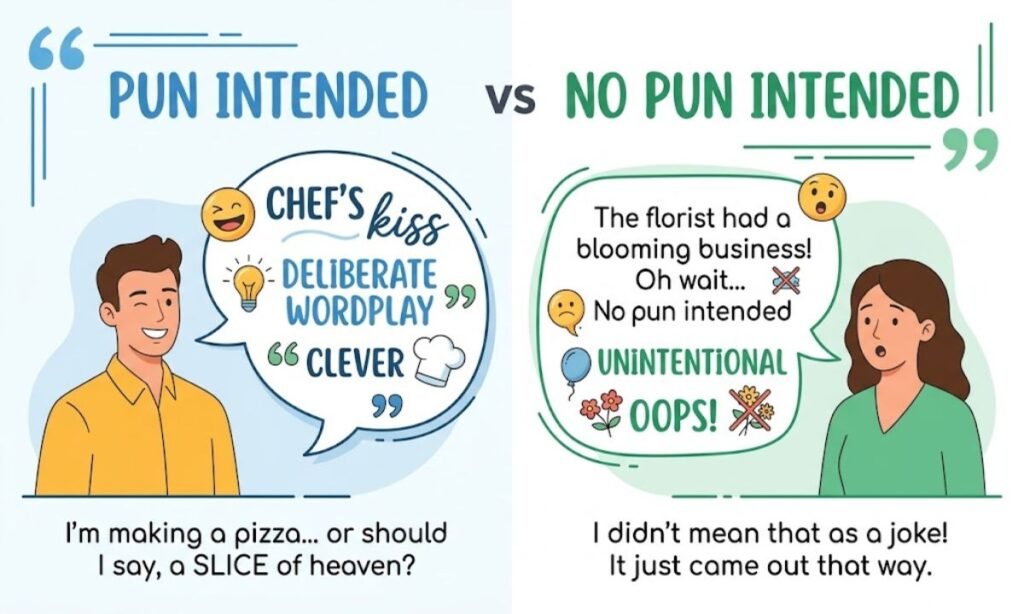
Although these two phrases look similar, they serve opposite purposes.
Pun Intended
“Pun intended” confirms that the wordplay was deliberate. The speaker planned the joke and wants credit for it.
No Pun Intended
“No pun intended” is used when a double meaning appears in a sentence by accident. The speaker did not plan it, but once they notice it, they point it out to avoid confusion or unwanted humor.
Quick Comparison
| Feature | Pun Intended | No Pun Intended |
| Purpose | Confirms deliberate wordplay | Clarifies accidental double meaning |
| Tone | Playful, proud of the joke | Often apologetic or clarifying |
| Timing | Used right after a planned pun | Used when a pun is noticed unintentionally |
| Example | “That joke really cracked me up, pun intended.” | “This project is a disaster, no pun intended.” |
What Does Pun Intended, Perhaps Mean?
Sometimes people add “perhaps” to soften the phrase, saying something like “pun intended, perhaps.” This adds a layer of humility or uncertainty, as if the speaker is letting the listener decide whether the pun was really planned. It keeps the tone light and slightly self-deprecating.
Why Do People Say Pun Intended?
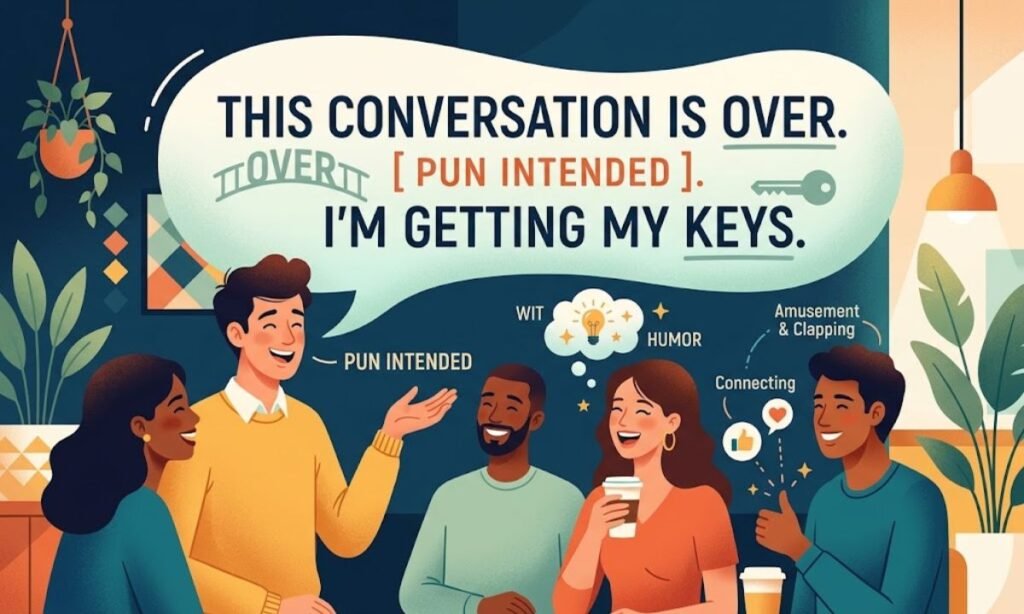
There are a few clear reasons this phrase has become so common in everyday language.
1. Social Signaling of Humor
Saying it signals to others that a joke was made on purpose, inviting them to laugh along or appreciate the cleverness.
2. Avoiding Confusion
Without it, listeners might think a double meaning was an error rather than a joke. The phrase clears up that confusion instantly.
3. Enhancing Wit
It draws attention to clever wordplay that might otherwise be missed, giving the joke more impact.
4. Building Rapport
Sharing a pun and confirming it was intended can create a light, friendly moment between speaker and listener, often sparking a smile or a groan.
Can a Pun Be Unintentional?
Yes, puns can absolutely happen by accident. Language is full of words with multiple meanings, so double meanings often show up without anyone planning them. This is exactly why “no pun intended” exists, to acknowledge those accidental moments.
Is Saying Pun Intended Rude or Clever?
Generally, saying “pun intended” is seen as clever rather than rude. It shows confidence in one’s own humor. However, context still matters.
Appropriate Contexts
Casual conversations, social media, blogs, and light-hearted writing are all good places for this phrase.
Situations to Avoid
Formal reports, legal documents, or serious announcements are usually not the right place for playful wordplay.
Overusing It
Using the phrase too often can make jokes feel forced or reduce their impact over time.
Using It Without a Real Pun
Sometimes people add “pun intended” even when there is no real double meaning, which can confuse readers rather than amuse them.
Using It in Serious Writing
Adding it during serious or emotional writing can come across as tone-deaf, since it shifts focus away from the main message.
Misunderstanding Double Entendre
A double entendre often carries a hidden, sometimes suggestive meaning. Confusing this with a simple pun can lead to awkward or unintended interpretations.
Pun intended meaning in english
In English, “pun intended” simply confirms that a play on words within a sentence was crafted on purpose. It is widely understood across casual and semi-formal English communication, especially in writing, jokes, and social commentary.
No pun intended meaning
“No pun intended” means the speaker noticed a double meaning in their own words after saying them, and wants to clarify it was not deliberate. It often appears when a word choice accidentally sounds like a joke about a serious topic.
Pun meaning
At its core, a pun is a form of wordplay that uses similar-sounding words or multiple meanings of a single word to create humor. It is one of the oldest and most common forms of verbal comedy.
Pun intended meaning and examples
The pun intended meaning becomes clearer through examples. For instance, saying “the broken vacuum was just gathering dust, pun intended” shows how a phrase can be read literally and figuratively at once, with the phrase confirming the double meaning was planned.
Also Read This Post https://punpath.com/pun-examples-funny/
Pun intended meaning synonyms
While there is no single-word synonym, similar phrases include “wordplay intended,” “double meaning intended,” or simply “see what I did there?” Each serves the same purpose of pointing out deliberate humor.
Pun intended meaning in farsi
There is no exact one-word equivalent for “pun intended” in Farsi, since the phrase is tied closely to English wordplay habits. However, the idea can be explained as جناس عمدی بود, meaning “the wordplay (jinas) was intentional.” Farsi does have its own tradition of wordplay, known as “jinas,” so the concept translates naturally even without a direct phrase-for-phrase match.
No pun intended meaning examples
- “This diet is the pits, no pun intended.” – Refers to fruit pits or discomfort in food choices.
- “The stock market really tanked, no pun intended.” – “Tanked” was not meant as a play on words.
- “The bakery closed and it really takes the cake, no pun intended.” – Points out an accidental double meaning tied to baking.
Pun intended vs no pun intended meaning
The core difference lies in intention. “Pun intended” celebrates a planned joke, while “no pun intended” clarifies an unplanned one. Both phrases exist because language naturally creates double meanings, and speakers want to control how those meanings are understood.
Final Thoughts: Make Every Quiz Night Fun and Memorable+
Puns are more than just a passing joke, they are a fun way to bring people together. Whether you drop a clever pun in conversation or build a whole quiz night around wordplay, that shared moment of “oh, I see what you did there” is what makes language genuinely enjoyable.
If you host trivia or quiz nights, puns are an easy way to add personality to the evening. A few well-placed pun-based questions or category names can turn a simple quiz into something people talk about long after it ends.
Frequently Asked Questions
Why do people say “pun intended”?
To make sure listeners know the wordplay was deliberate, so the joke actually lands.
What is the difference between “pun intended” and “no pun intended”?
“Pun intended” confirms a planned joke, while “no pun intended” clarifies an accidental one.
Can you use “pun intended” in a classy Instagram bio?
Yes, a short pun followed by “pun intended” can make a classy Instagram bio feel witty without trying too hard.
Is “pun intended” formal or casual?
It’s casual, best used in everyday talk, social captions, or light writing rather than formal documents.
What is an example of “pun intended”?
“This bakery really rises to the occasion, pun intended” is a simple, everyday example.
Is it okay to end a bio with “pun intended”?
Yes, it’s a popular trick for a classy Instagram bio because it adds humor in just a few words.
What does “no pun intended” mean in a sentence?
It means a double meaning slipped in by accident, and the speaker wants to clarify that.
Does “pun intended” work in Farsi too?
Farsi has its own wordplay tradition called “jinas,” so the idea translates even without an exact phrase match.
Why is “pun intended” popular on social media?
Because short, clever wordplay fits perfectly into captions, especially in a classy Instagram bio or witty post.Have you ever heard someone say a joke and then add, “pun intended”? It’s a common phrase people use in writing and speech. It shows that a play on words was made on purpose. This little phrase helps readers catch the joke they might have missed.
The term “pun intended” means the speaker or writer chose their words for a double meaning. It signals that the wordplay was not an accident. People add it right after a pun to point out the humor. This makes the joke land better and avoids confusion.
You can find “pun intended” used everywhere today. It shows up in casual talk, social media posts, and even in articles. Writers use it to add humor and connect with readers. Understanding this phrase helps you enjoy wordplay and use it well yourself.
What Does Pun Intended Mean?
When someone says “pun intended,” they are letting you know that a joke or double meaning in their sentence was made on purpose. It is a small phrase, but it does a big job. It tells the reader or listener that the wordplay they just noticed was not an accident.
Simple Definition
The simple pun intended meaning is this: the speaker chose their words deliberately to create a joke based on double meaning. Instead of leaving people to wonder if a pun was clever or clumsy, the phrase confirms it was clever on purpose.
Explore More Clever Wordplay and Funny Reads
If you enjoy this kind of language humor, there is a whole world of wordplay worth exploring, from classic dad jokes to clever headlines that use double meanings for comedic effect.
Why It Is Used
People use this phrase mainly to make sure their humor lands. Without it, a pun might slip by unnoticed, especially in text or writing where tone is harder to read. Adding the phrase gives the joke a small spotlight.
What Is a Pun? Understanding Wordplay First
Before the phrase makes full sense, it helps to understand what a pun actually is. A pun is a form of wordplay that uses a word with two meanings, or two words that sound alike, to create a humorous effect. It relies on double meaning, and often works because of how flexible language can be.
For example, saying “I used to be a baker, but I couldn’t make enough dough” plays on the word “dough,” which means both bread mixture and money. That overlap is what makes it a pun.
Types of Puns
Puns generally fall into a few common categories:
- Homophonic puns – use words that sound the same but have different meanings, like “sole” and “soul.”
- Homographic puns – use one word with multiple meanings, like “light” meaning both “not heavy” and “not dark.”
- Compound puns – combine two or more puns in a single sentence for extra effect.
Each type relies on double entendre or double meaning to create the humor, but they get there in slightly different ways.
How Pun Intended Is Used in Sentences
Once a pun has been made, the phrase is usually added right after it, almost like a wink to the reader.
Placement
Most commonly, “pun intended” appears immediately after the pun itself, often set off by a comma or parentheses. This placement keeps the joke close to its explanation.
In Written English
In writing, the phrase is especially useful because tone of voice is missing. A reader cannot hear sarcasm or playfulness the way a listener can, so the phrase helps signal that a joke was meant.
In Spoken English
In speech, people sometimes use it for comedic timing, pausing briefly before adding “pun intended” for extra effect. It can also be used casually, almost as a verbal nudge.
Ten Practical Examples
- “The math teacher said problems make her add up her patience, pun intended.” – The pun plays on “add up,” referencing both math and patience.
- “I’m reading a book about anti-gravity. It’s impossible to put down, pun intended.” – “Put down” refers to both stopping reading and gravity.
- “The electrician was shocked by his own bill, pun intended.” – “Shocked” ties electricity to surprise.
- “The baker stopped making bread because he kneaded a break, pun intended.” – “Kneaded” sounds like “needed.”
- “The calendar’s days are numbered, pun intended.” – Plays on “numbered” meaning both dates and limited time.
- “She had a photographic memory but never developed it, pun intended.” – “Developed” links photography and personal growth.
- “The dentist won an award for his outstanding work, pun intended.” – “Outstanding” refers to both quality and unpaid dues.
- “The fisherman’s jokes were reel funny, pun intended.” – “Reel” replaces “real” while nodding to fishing gear.
- “The clock maker’s business was ticking along nicely, pun intended.” – “Ticking” ties directly to clocks.
- “The gardener’s business really grew over time, pun intended.” – “Grew” connects plants and business success.
Each example works because the sentence carries a double meaning, and the phrase afterward confirms the wordplay was intentional.
Pun Intended vs No Pun Intended: What Is the Difference?
Although these two phrases look similar, they serve opposite purposes.
Pun Intended
“Pun intended” confirms that the wordplay was deliberate. The speaker planned the joke and wants credit for it.
No Pun Intended
“No pun intended” is used when a double meaning appears in a sentence by accident. The speaker did not plan it, but once they notice it, they point it out to avoid confusion or unwanted humor.
Quick Comparison
| Feature | Pun Intended | No Pun Intended |
| Purpose | Confirms deliberate wordplay | Clarifies accidental double meaning |
| Tone | Playful, proud of the joke | Often apologetic or clarifying |
| Timing | Used right after a planned pun | Used when a pun is noticed unintentionally |
| Example | “That joke really cracked me up, pun intended.” | “This project is a disaster, no pun intended.” |
What Does Pun Intended, Perhaps Mean?
Sometimes people add “perhaps” to soften the phrase, saying something like “pun intended, perhaps.” This adds a layer of humility or uncertainty, as if the speaker is letting the listener decide whether the pun was really planned. It keeps the tone light and slightly self-deprecating.
Why Do People Say Pun Intended?
There are a few clear reasons this phrase has become so common in everyday language.
1. Social Signaling of Humor
Saying it signals to others that a joke was made on purpose, inviting them to laugh along or appreciate the cleverness.
2. Avoiding Confusion
Without it, listeners might think a double meaning was an error rather than a joke. The phrase clears up that confusion instantly.
3. Enhancing Wit
It draws attention to clever wordplay that might otherwise be missed, giving the joke more impact.
4. Building Rapport
Sharing a pun and confirming it was intended can create a light, friendly moment between speaker and listener, often sparking a smile or a groan.
Can a Pun Be Unintentional?
Yes, puns can absolutely happen by accident. Language is full of words with multiple meanings, so double meanings often show up without anyone planning them. This is exactly why “no pun intended” exists, to acknowledge those accidental moments.
Is Saying Pun Intended Rude or Clever?
Generally, saying “pun intended” is seen as clever rather than rude. It shows confidence in one’s own humor. However, context still matters.
Appropriate Contexts
Casual conversations, social media, blogs, and light-hearted writing are all good places for this phrase.
Situations to Avoid
Formal reports, legal documents, or serious announcements are usually not the right place for playful wordplay.
Overusing It
Using the phrase too often can make jokes feel forced or reduce their impact over time.
Using It Without a Real Pun
Sometimes people add “pun intended” even when there is no real double meaning, which can confuse readers rather than amuse them.
Using It in Serious Writing
Adding it during serious or emotional writing can come across as tone-deaf, since it shifts focus away from the main message.
Misunderstanding Double Entendre
A double entendre often carries a hidden, sometimes suggestive meaning. Confusing this with a simple pun can lead to awkward or unintended interpretations.
Pun intended meaning in english
In English, “pun intended” simply confirms that a play on words within a sentence was crafted on purpose. It is widely understood across casual and semi-formal English communication, especially in writing, jokes, and social commentary.
No pun intended meaning
“No pun intended” means the speaker noticed a double meaning in their own words after saying them, and wants to clarify it was not deliberate. It often appears when a word choice accidentally sounds like a joke about a serious topic.
Pun meaning
At its core, a pun is a form of wordplay that uses similar-sounding words or multiple meanings of a single word to create humor. It is one of the oldest and most common forms of verbal comedy.
Pun intended meaning and examples
The pun intended meaning becomes clearer through examples. For instance, saying “the broken vacuum was just gathering dust, pun intended” shows how a phrase can be read literally and figuratively at once, with the phrase confirming the double meaning was planned.
Pun intended meaning synonyms
While there is no single-word synonym, similar phrases include “wordplay intended,” “double meaning intended,” or simply “see what I did there?” Each serves the same purpose of pointing out deliberate humor.
Pun intended meaning in farsi
There is no exact one-word equivalent for “pun intended” in Farsi, since the phrase is tied closely to English wordplay habits. However, the idea can be explained as جناس عمدی بود, meaning “the wordplay (jinas) was intentional.” Farsi does have its own tradition of wordplay, known as “jinas,” so the concept translates naturally even without a direct phrase-for-phrase match.
No pun intended meaning examples
- “This diet is the pits, no pun intended.” – Refers to fruit pits or discomfort in food choices.
- “The stock market really tanked, no pun intended.” – “Tanked” was not meant as a play on words.
- “The bakery closed and it really takes the cake, no pun intended.” – Points out an accidental double meaning tied to baking.
Pun intended vs no pun intended meaning
The core difference lies in intention. “Pun intended” celebrates a planned joke, while “no pun intended” clarifies an unplanned one. Both phrases exist because language naturally creates double meanings, and speakers want to control how those meanings are understood.
Final Thoughts: Make Every Quiz Night Fun and Memorable+
Puns are more than just a passing joke, they are a fun way to bring people together. Whether you drop a clever pun in conversation or build a whole quiz night around wordplay, that shared moment of “oh, I see what you did there” is what makes language genuinely enjoyable.
If you host trivia or quiz nights, puns are an easy way to add personality to the evening. A few well-placed pun-based questions or category names can turn a simple quiz into something people talk about long after it ends.
Frequently Asked Questions
Why do people say “pun intended”?
To make sure listeners know the wordplay was deliberate, so the joke actually lands.
What is the difference between “pun intended” and “no pun intended”?
“Pun intended” confirms a planned joke, while “no pun intended” clarifies an accidental one.
Can you use “pun intended” in a classy Instagram bio?
Yes, a short pun followed by “pun intended” can make a classy Instagram bio feel witty without trying too hard.
Is “pun intended” formal or casual?
It’s casual, best used in everyday talk, social captions, or light writing rather than formal documents.
What is an example of “pun intended”?
“This bakery really rises to the occasion, pun intended” is a simple, everyday example.
Is it okay to end a bio with “pun intended”?
Yes, it’s a popular trick for a classy Instagram bio because it adds humor in just a few words.
What does “no pun intended” mean in a sentence?
It means a double meaning slipped in by accident, and the speaker wants to clarify that.
Does “pun intended” work in Farsi too?
Farsi has its own wordplay tradition called “jinas,” so the idea translates even without an exact phrase match.
Why is “pun intended” popular on social media?
Because short, clever wordplay fits perfectly into captions, especially in a classy Instagram bio or witty post.
